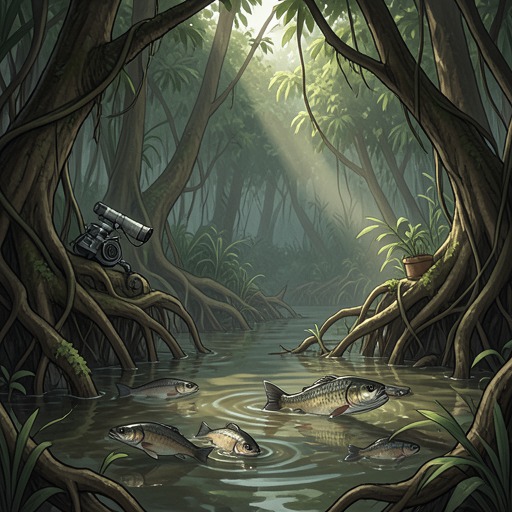
Indian River
Silent SpringIndian River, on Florida’s eastern coast, is presented as part of a connected coastal landscape where salt marshes, estuaries, and sheltered inlets sustain abundant aquatic life. In the spring of 1955, a dieldrin treatment of marshland in St. Lucie County caused extensive deaths among that life, making the river country a stark example of the consequences of insect control that fails to remain confined to its target.
Setting and ecological connections
The account places Indian River within a broader coastal system of salt marshes and quiet inlets, environments in which the effects of pesticides can spread beyond the immediate treatment area. The marshes were not an isolated tract: their waters supported fish and crustaceans, while their connection to the river meant that damage to marsh life also implicated the surrounding aquatic landscape.
The 1955 marsh treatment
In the spring of 1955, about 2,000 acres of salt marsh in St. Lucie County were treated with dieldrin to eliminate sandfly larvae. The application used one pound of active ingredient per acre. The stated target was insect larvae, but the ensuing survey found that the effect on aquatic life was catastrophic. Scientists from the Entomology Research Center of the State Board of Health reported that the fish kill was substantially complete.
Scale and consequences
The immediate toll across the marshes, not including the Indian River shoreline, was estimated at a minimum of 20 to 30 tons of fish—about 1,175,000 individuals belonging to at least 30 species. No fish species was spared; among those reported dead were mullets, snook, mojarras, and gambusia. The episode thus registers not as a narrowly localized loss but as damage to a diverse community of fish throughout the treated marshes.
The effects differed among groups of aquatic animals. Mollusks seemed unharmed by dieldrin, whereas crustaceans were virtually exterminated throughout the area. Sharks were observed moving in from the air over the marshes, attracted by dying fish. This contrast between the apparent survival of mollusks and the near-total losses among fish and crustaceans underscores the uneven, yet far-reaching, consequences of applying a persistent insecticide in a connected wetland environment.
Significance in the book
Indian River serves as the geographical frame for an account of consequences that outran the stated purpose of pest control. A treatment directed at sandfly larvae was followed by losses across numerous fish species and the near-eradication of crustaceans in the marshes. By placing the event in a coastal system of marshes and inlets, the narrative makes the wider ecological dependence of these waters central to understanding the disaster.